Send one event per thing that happened
A name, a customer, and whatever you want to count. Meters do the rest.
- 1POST /v1/events/ingest
- 2
- 3{
- 4 "events": [{
- 5 "name": "llm.completion",1
- 6 "external_customer_id": "cus_4410",2
- 7 "metadata": {3
- 8 "model": "claude-sonnet",
- 9 "tokens": 1840
- 10 }
- 11 }]
- 12}
- name
- What happened. Meters filter on it.
- external_customer_id
- Who it is billed to.
- metadata
- Anything to add up: tokens, bytes, seconds.
1
2
3
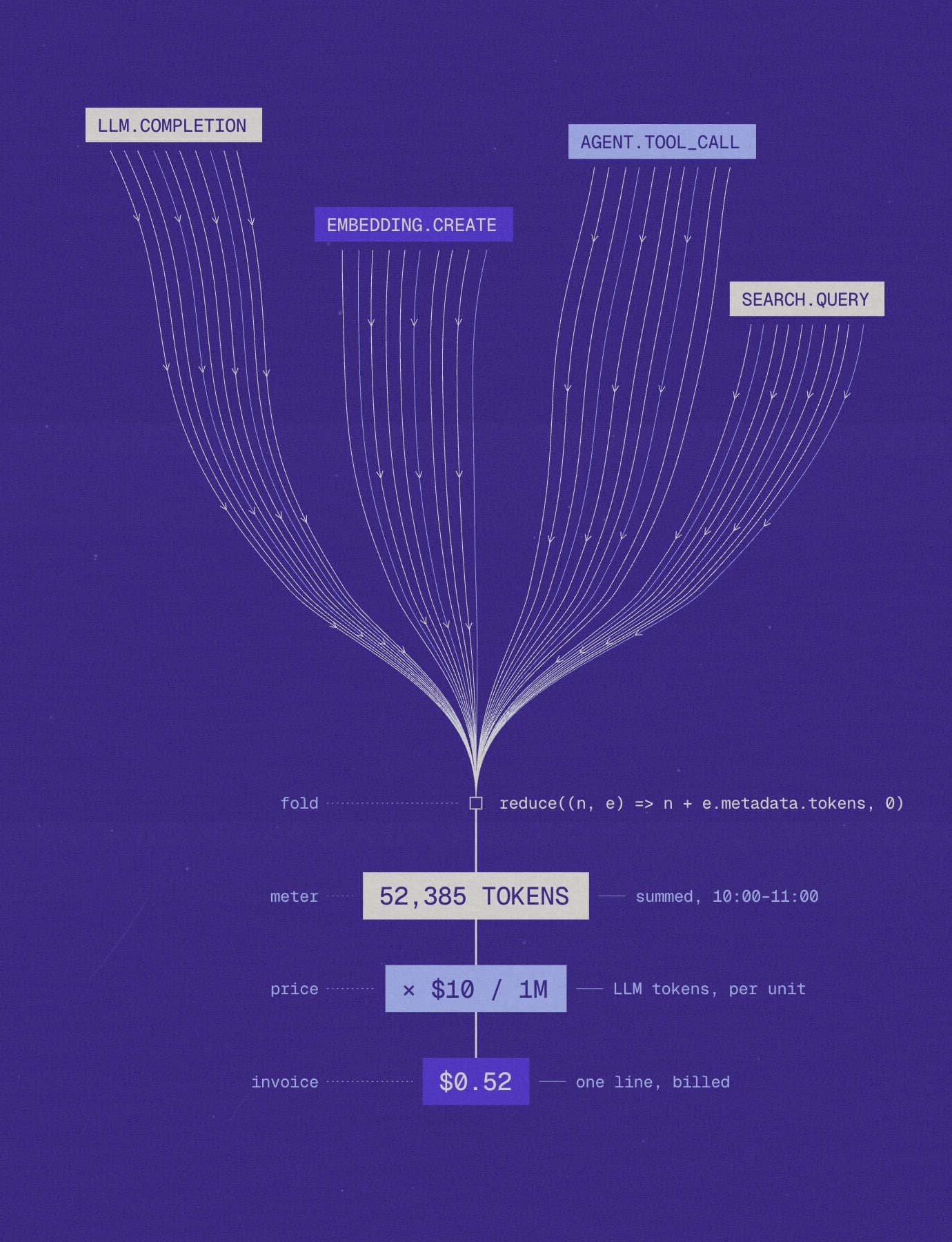
One number per customer, from the whole stream
1Filter
Which events count: here, LLM completions.
2Aggregation
How they add up: the sum of their tokens.
Per customer
Every customer gets their own number.
Per period
Read at the end of each billing cycle.
Five ways to read the same stream
A meter's aggregation decides what its number means. The same thirty-one events, read five ways.
count()31
12345678910111213141516171819202122232425262728293031
Priced per unit, billed on the next invoice
Renewals, proration, tax and discounts work as they do for fixed prices.
Every customer's balance, as it happens
What they have used, what they were granted, and what is left, as each event lands.
- Credits
- Grant units with the meter credits benefit. What is left can roll over to the next cycle.
- API
- Consumed units, credited units and balance, per customer and meter.
- Customer state
- Every active meter is on the customer state, and its webhook fires when it changes.
- Customer portal
- Customers see their own usage, without you building a page for it.
Start metering events
Set up a meter and ingest your first event with the SDK.